Definition
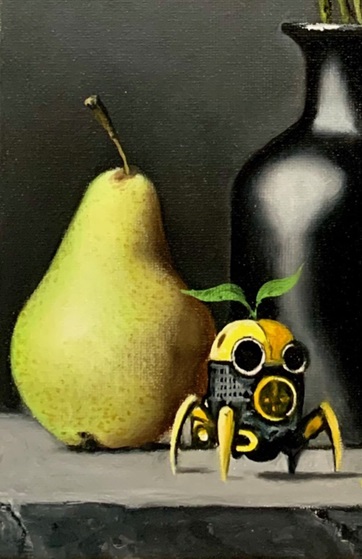
Bionantism is a term that defines cogenesis – the simultaneous emergence of organic and technological elements.

In art, biological and technical elements are not added later, but are born together, forming unitary and balanced visual structures.

Bionantism defines a visual reality in which the organic and the technical coexist from the same beginning.
Definition
Bionantism is an artistic theme in contemporary painting that explores the relationship between nature and technology through the concept of cogenesis.
In Bionantism, biological and technical elements are not subsequently combined and do not function symbolically, but are conceived as born simultaneously, forming a unitary and visually coherent structure.
The theme proposes a visual verisimilitude based on the internal coherence of the image and the formal balance between the organic and the technical, without resorting to metaphor, activism or speculative aesthetics.
About Bionantism
Context and delimitation
In contemporary painting, despite its diversity, numerous visual themes address the relationship between nature and technology. Most of the time, this relationship is treated in a moral, critical or activist key, not as an autonomous aesthetic structure.

A conceptual void is thus created: technology is frequently represented either as a danger or as a decorative element, and nature appears idealized or presented as a relic to be saved, not as a form that integrates technology from its very essence.

Other visual themes, which explore the relationship between the natural and the artificial through fantasy, speculative, futuristic or dystopian registers, usually construct symbolic or narrative worlds. In these approaches, the relationship between bio and technology remains either excessively symbolic or strictly technical, without proposing a coherent aesthetic vision in which technology functions as a native part of nature.The origin of the theme
Around 2023, Mihai Ionescu formulates the theme of Bionantism as a response to this conceptual void, starting from a concern for static nature in painting. The idea that a fruit or a flower contains mechanisms at their core is not treated as a visual game or metaphor, but as a natural possibility, as a form of its own existence.

In these works, the organic and the mechanical are not subsequently joined, but seem to grow together, suggesting a common origin. Not fitting into other established themes of the nature-technology relationship, this approach was defined by a proper name: Bionantism.
Bionantism thus designates both an artistic theme and a conceptual term, formulated to concentrate, in a single word, the idea of the simultaneous birth of organic and technological elements, avoiding repetitive descriptive explanations.Gradually, the theme went beyond the framework of fruits and flowers, expanding towards landscapes and larger plant structures, in which roots, fibers or branches naturally continue into technological forms. Other living things can be represented in the same logic, preserving the principle of cogenesis between bio and technical.Features
Bionantism functions as a distinct visual code: a world in which the natural and the artificial no longer complement or oppose each other, but coexist as a single organically rewritten reality.

The theme does not refer to real biological possibility, but to a visual verisimilitude, built on formal coherence and the internal logic of the image, not on scientific validation.

Bionantism does not imagine futures and does not offer solutions.

It is a visual radiography of an already transformed bios, in which metamorphosis is no longer a process, but a state of affairs.

Its aesthetic code is precise: it excludes magic, retro aesthetics, fairy tales, ideology and ecological messages.

Bionantism does not promise, does not warn or save.

It just shows.

No morality. No nostalgia. Just result.

A visual code, simply.
Principles of bionantism
1. There is no boundary between nature and technology.

Everything that lives is born with technical mechanisms integrated into its own structure.

2. Life is not an exclusive invention of nature.

Technology is not an exclusive creation of man.
Both are expressions of the same material breath.

3. In Bionantism, the leaf and the circuit do not meet and do not subsequently complete each other — they grow from the same cell.

Cogenesis must be visually recognizable, without further explanation, from the first contact with the image.

4. The biological and the technical are not opposing elements, but co-originating forms of the same reality.

In bionantistic works, the machine is not an invader, and the organism is not a victim.

They constitute a single form of existence, perceptible through two lenses of the same matter.

5. Bionantism refuses the aesthetics of contrast and catastrophe.
Harmony is not a compromise, but the profound expression of the structure of the world.

6. The bionantic artist does not build or intervene, but discovers.
He brings to the surface the latent logic through which life and mechanism intertwine.
7. Each bionantic work visually asserts the impossibility of separating the natural and the artificial. It appears as a single organism contemplating its own structure.
Why Bionantism?
In contemporary art, there is a significant conceptual gap: the cogenesis between nature and technology is rarely addressed in painting in a coherent and visually plausible manner. Although literature and philosophy explore this territory, the visual arts lack a clear, recognizable language free of gratuitous fantasy.
Bionantism fills this gap—not through metaphors or messages, but through its own visual code, where technology does not invade nature but is already embedded in its biological structure.
Not only beings, but also landscapes, objects, and matter itself appear transformed—not as the result of a process, but as a natural state.
Bionantism does not propose possible futures. It proposes images of an already altered present.
Bionantism is not Solarpunk, Biopunk, Eco-Art, Fantasy, or any other contemporary movement. It does not propose utopias, issue warnings, idealize, or include magic or activism.
It is a distinct artistic theme that explores a world where nature has integrated technology into its own biological structure. They do not coexist. They do not collaborate. They rewrite together, forming a new visual order.
Bionantism does not imagine a future nor offer solutions. It is an artistic radiograph of a bios already transformed, stable, and coherent—a universe where metamorphosis is no longer a process, but a state of being.
Its aesthetic code intentionally excludes:
– Retro-Victorian aesthetics (steampunk);
– Fantasy, fairy tales, and magical fiction;
– Ecological, moral, or ideological messages.
Bionantism is a metamorphosis without conflict, without nostalgia, and without promise. Just outcome. A silent, yet radical outcome.
The Fundamental Values of Bionantism
In Bionantism, technology is neither an addition to nature nor a disruptive factor. It is not foreign, because it is no longer separable. There are no longer two interacting entities, but a single restructured biological reality, in which mechanical elements are part of the living code. There is no harmony. There is no conflict. There is only transformation – complete, silent, and irreversible.
1. The symbiosis between nature and technology
Unlike other movements that glorify fantasy, utopia, or dystopia, Bionantism presents a cogenesis between the organic and the technological that is neither metaphor nor magic. It is a plausible, coherent, and functional visual construction, in which technology does not accompany organic life but is already integrated into its structure. There is no balance. There is no tension. There is only outcome.
2. Balance and plausibility
Through specific colors, textures, and compositions, Bionantism builds a recognizable visual code in which organic forms and technical structures do not merely coexist—they flow into one another. Living textures extend seamlessly into mechanical surfaces. Bodies are not “modified” or “augmented”—they have grown this way. The aesthetics of Bionantism do not imitate the future. They depict it as already realized.
3. Exploring contemporary aesthetics
Ecological crises and the invasion of technology into the biosphere are global realities. Bionantism does not offer solutions, nor does it criticize or propose models. It does not seek balance—it shows a result: a reconfigured bios where nature and technology can no longer be separated. Precisely through this absence of judgment, the theme gains universal relevance. It does not ask for the viewer’s approval. It simply reveals.
4. The universality of the theme
Bionantism in the Visual Arts
Bionantism finds its expression in painting, sculpture, digital art and other visual forms through a distinctive language that is clear and easily recognizable:
– bio-technical still lifes: fruits, objects, plants or living creatures in which the technological elements are not added afterwards, but are part of the structure from the very beginning;
– floral themes: bouquets, vases or floral compositions where technical details grow organically together with the flowers;
– landscapes: natural structures, trees or vegetation in which technological components develop side by side with the biological ones, forming a single body without visible boundaries.
The author has deliberately excluded human portraits from Bionantism. The reason is straightforward: including them would dilute its aesthetic identity and bring the theme too close to areas already explored, such as surrealism, fantasy or steampunk. However, in exceptional cases, when the human figure is not treated as a portrait but merely as a support to illustrate an irreversible cogenesis, present from birth, between the organic and the technical, the work can be included within Bionantism.
In a world where the boundaries between natural and artificial have faded, Bionantism does not describe a process of transformation. It presents existences born directly into this irreversible cogenesis of the organic and the technical.
A Call to Action
Bionantism is not just an artistic direction, but a clear visual proposal—defined through works, not theory. It is an open theme where painters, sculptors, or digital artists can contribute not through stylistic variation, but through coherence of vision.
Anyone who understands the visual code of Bionantism—the plausible and irreversible cogenesis between bios and technology—becomes part of its ongoing definition.
Clarifying the Identity of Bionantism
The theoretical definition of Bionantism is essential to distinguish it from other visual forms that may appear similar on the surface.
It is not Steampunk—there is no retro aesthetic, no decorative mechanisms, no period context.
It is not Fantasy—there is no magic, fairy tale, or dreamlike escape.
It is not Surrealism—it does not generate dream or absurdity. It produces the plausible, without metaphor.
An apple with an internal mechanism may seem surrealist to the inattentive viewer, but in Bionantism, it is not a symbol, not a dream. It is structure.
The differences between Bionantism and other themes
Fantasy in Painting
Definition:
Fantasy is an artistic genre that explores supernatural worlds populated by mythological creatures, magic, and impossible settings.
Characteristics:
– Elements such as dragons, wizards, and magical realms;
– Emphasis on narrative, dreamlike or epic atmosphere;
– Technology often plays a symbolic, fantastical, or decorative role;
– Commonly associated with fantasy literature and video game culture.
Bionantism
Replaces magic and the supernatural with a plausible biological-technological cogenesis.
It does not imagine magical or parallel worlds, but a bios already transformed—where technology is part of the structure, not a decoration or mystery.
There are no mythical creatures—only life forms biologically modified in a coherent way.
It does not use fantastic symbolism, but a functional visual code, without metaphors.
Conclusion:
Fantasy means escape through magic.
Bionantism means rewritten reality, without magic. Only structure.
Steampunk in Painting
Definition:
Steampunk is a visual style that blends retro-futuristic technology with Victorian-era elements in an often fantastical industrial setting.
Characteristics:
– Steam-powered machinery, gears, clocks, and visible tubing;
– Heavy, metallic décor with elaborate ornaments and vintage details;
– Evokes the industrial past, enhanced with fictional extensions;
– The atmosphere is often theatrical, mechanical, and decorative.
Bionantism
Completely avoids any retro aesthetic. There are no references to past eras or heavy décors.
It does not use steam, rivets, iron railings, or mechanical lacework.
Technology appears subtle, plausible, and biologically integrated—as if it had grown there.
It is not nostalgic and does not recycle the past.
It doesn’t decorate. It doesn’t exaggerate. It doesn’t shout. It simply composes.
Surrealism in Painting
Definition:
Surrealism is an artistic movement that explores the subconscious, dreams, and the irrational, building illogical, absurd, or distorted images.
Characteristics:
– Unnatural juxtapositions of objects or contexts;
– Distorted or symbolic forms placed in inexplicable settings;
– Emphasis on inner states, the subconscious, and spontaneity;
– Visual elements do not require functional coherence—only emotional or dreamlike impact.
Bionantism:
Avoids illogicality, symbolism, and absurdity.
It does not suggest dreams or metaphors.
Compositions are built with an internal, plausible logic—structural, not emotional.
Forms do not distort reality, but create a biologically-technological world that could exist.
It does not seek interpretation. It simply asks to be observed.
Conclusion:
Surrealism provokes through the illogical.
Bionantism convinces through coherence.
In Bionantism, the image does not illustrate an idea or support a theoretical discourse. It functions autonomously, based on a clear structural principle: the cogenesis of the biological and the technical.

Cogenesis, in Bionantism, is not a metaphor and is not an explanatory concept. It represents the simultaneous birth of biological and technical elements as a unitary structure, without subsequent intervention, without progressive transformation, and without ideological commentary.
Unlike posthumanist approaches, which interpret the relationship between man and technology,

Bionantism does not discuss man or problematize identity. It does not explore possible futures or formulate speculative hypotheses.
Bionantism presents a visual reality treated as a state of affairs, not as a process and not as a becoming. The metamorphosis is already consummated, and the image does not explain this transformation, but shows it.

While posthumanism can read and interpret bionantist works from a theoretical perspective, this reading is external to the subject. Bionantism is not constructed as part of posthumanism and does not depend on it to function.

The essential difference is one of level: posthumanism is a grid of interpretation;
Bionantism is an autonomous visual code.
Bionantism does not use the image to say anything about the world.
The image is the world, as it is defined by cogenesis.
The Future of Bionantism
The visual and conceptual characteristics of themes such as fantasy or steampunk are already well defined but can cause confusion when compared to Bionantism. To avoid this overlap, it is essential to emphasize that Bionantism clearly distances itself from both directions: it completely excludes the magic and supernatural elements of fantasy and rejects the mechanical nostalgia and retro-industrial aesthetics typical of steampunk. Instead, it proposes a balanced and realistic cogenesis between nature and technology—a coherent vision where the two components do not oppose but coevolve.
Although themes like the nature–technology relationship have been addressed in contemporary art—in Solarpunk, Eco-Art, or conceptual installations—these have been treated either from utopian perspectives or within a critical or purely decorative framework. What was missing was a unified aesthetic and theoretical framework capable of bringing these disparate intentions together into a recognizable direction. Bionantism fills this gap by proposing a distinct identity, where biological logic and technological functionality coexist in a new and coherent visual language.
Essentially, Bionantism is not an arbitrary cogenesis of forms but a clear stance: an artistic theme that redefines how we imagine the interaction between life and mechanism. It offers artists a well-defined territory and the audience a contemporary key for understanding, anchored in the major questions of today’s world.
More on https://www.tablouri-de-vis.ro